Before starting this tutorials I will suggest you that please read the " What is subnet Mask and What is Subnetting ? ( Part 1 )
So lets start .....
Prefix Notation
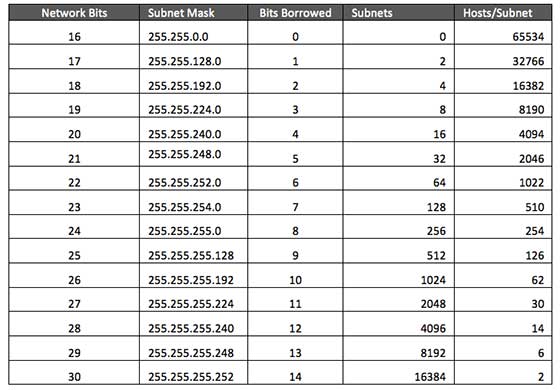
A subnet mask is written in the decimal or 32 bit binary number form. Prefix is an alternative represent the mask. Table 1 lists the default subnet masks using the network prefix notation for the subnet mask.
Address Class Bits for Subnet Mask Network Prefix
Class A 11111111 00000000 00000000 00000000 /8
Class B 11111111 11111111 00000000 00000000 /16
Class C 11111111 11111111 11111111 00000000 /24
For example, the class B network ID 138.96.0.0 with the subnet mask of 255.255.0.0 would be expressed in network prefix notation as 138.96.0.0/16.
Here 1 is known as Network bits or on bits
and 0 is known as Host bits or off bits.
The individual subnets and hosts can be determined through two basic formulas.
- Number of subnets = 2n where n is the number of bits borrowed to make the subnet mask or Number of borrowed on bits.
- Number of host per subnet = 2x-2
- Number of Bock size = 256 - New subnet
So here I am taking an example
sappose I take a 10.0.0.1 and prefix is /11
Solution
10.0.0.1 subnet prefix - /11
Then, Default subnet mask = 255.0.0.0
In subnet prefix notation = 255.11100000.0.0
Then Number of subnets = 2n _23 =8
Number of Bock size = 256 -
Number of host per subnet = 2x-2 = 2power 5 -2 =30
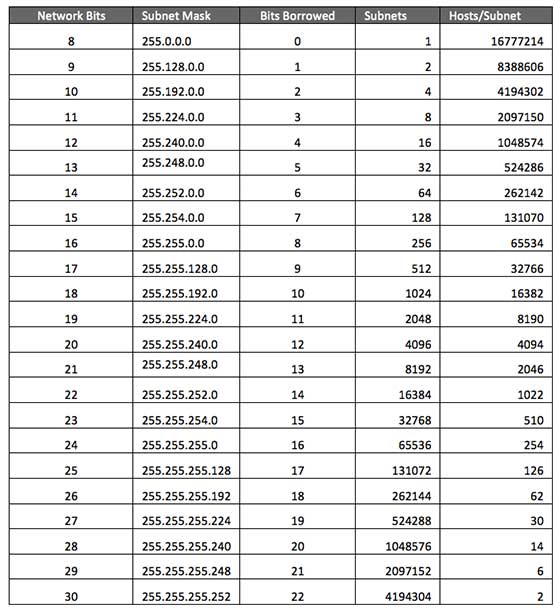
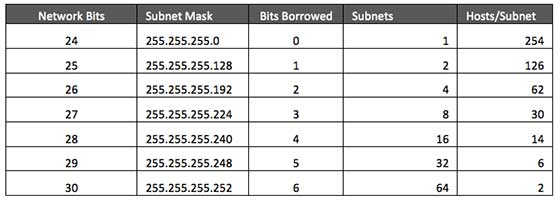
Number of Bock size = 256 -224 (as given in table which is in part 1)
=32
So I make a table
Block size 0 32 64 96 128 160 192 224
First IP 1 33 65 97 129 161 193 225
. . . . . . . .
. . . . . . . .
. . . . . . . .
Last IP 30 62 94 126 158 190 222 254
Block IP 31 63 95 127 159 191 223 255


 The easiest way to do this would be to follow our guide on